

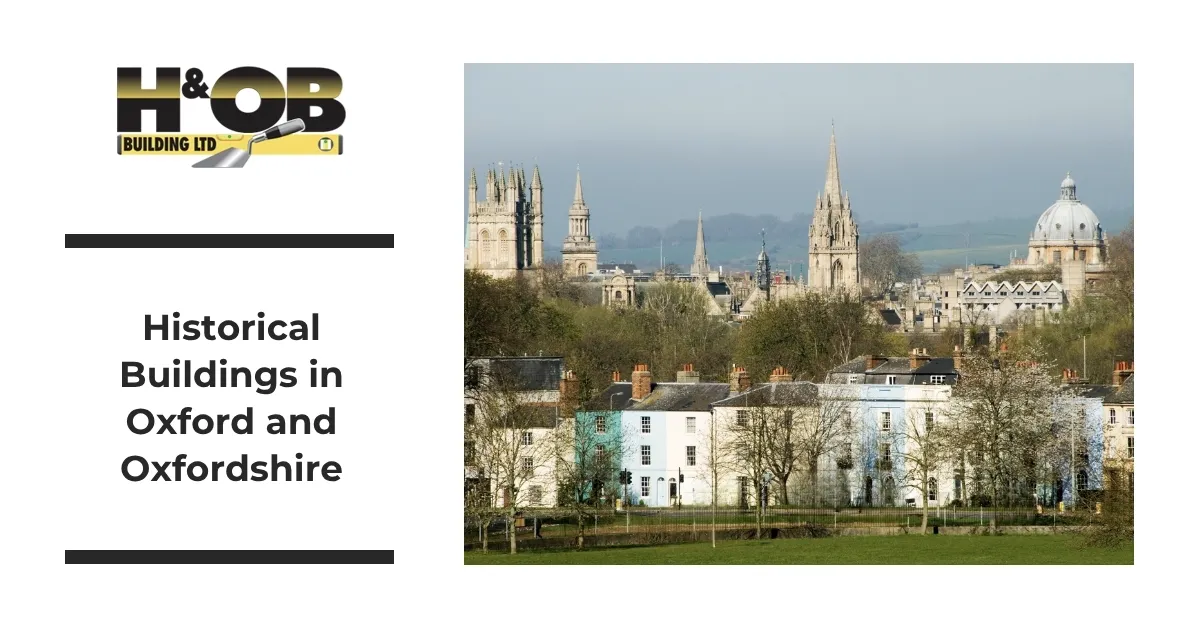
If you, like us, love stunning stonework, historical architecture, and world-class estates, Oxford is a treasure trove.
Oxford’s historical buildings offer a journey through time; from the honey-coloured local limestone that defines classic Oxford architecture to the grand estates nestled in the Oxfordshire countryside, the area is a living museum.
Here’s a comprehensive guide to Oxford’s historical buildings and architectural marvels you can visit, the minds that designed them and the history they hold.
The Oldest Building in Oxford
St George’s Tower at Oxford Castle
If you are looking for the oldest building in Oxford, this is it.
Built around 1020 AD, St George’s Tower was originally a defensive watchtower, later incorporated into the Norman castle.
The tower is a staggering piece of history. You can climb its ancient steps and take in panoramic views of the city, knowing you are standing on a structure that has watched over Oxford for a millennium.
St Michael at the North Gate
Often claimed to be the oldest building in Oxford, this church’s Anglo-Saxon tower is actually the second-oldest, built just 20 years after St George’s Tower, around 1040 AD. However, it does hold the title of the oldest surviving building within the original city walls!
Constructed from rough coral ragstone, it was built as a lookout post to defend the city’s northern gate from Viking attacks. St Michael at the North Gate is open to the public, and you can climb the tower for brilliant views.
Fun fact: the door to the prison cell where the Oxford Martyrs were held in 1555 is preserved inside the tower.
Collegiate Oxford Historical Buildings, Museums and Landmarks
The Divinity School
A masterpiece of English Perpendicular Gothic architecture, the Divinity School was built between 1427 and 1483. Originally designed by master mason Richard Winchcombe, the building’s most striking feature is its elaborate lierne vaulting, which boasts 455 carved stone bosses.
The Divinity School is part of the Bodleian Library tours and is widely celebrated by Harry Potter fans, as it served as the Hogwarts Infirmary in the films!
Radcliffe Camera
Designed by the renowned architect James Gibbs and completed in 1749, Radcliffe Camera, a Palladian-style circular library, is an iconic piece of Oxford architecture, built using local Headington and Taynton stone.
The library is open only to university members and via guided tours; however, viewing its dome from Radcliffe Square is an essential Oxford experience.
Oxford Town Hall
A stunning example of Jacobethan revival architecture, the current Town Hall was completed in 1897, designed by architect Henry Hare and built primarily of Clipsham stone. The town hall’s ornate exterior features beautiful bay windows, elaborate gables, and a striking clock tower.
Oxford Town Hall is open to the public and houses the Museum of Oxford.
Fun fact: The building famously hosted the trial of the postmaster in the book Alice in Wonderland.
Mob Quad (Merton College)
Built in the 13th and 14th centuries from local limestone, Mob Quad is considered the oldest academic quadrangle in Oxford, making it a landmark of collegiate Oxford architecture.
Visitors can pay a small fee to tour Merton College and take in its traditional Gothic architecture, characteristic pointed arches, stone mullioned windows, and battlements.
Fun fact: J.R.R. Tolkien was a professor at Merton, and he frequently spent time in these medieval surroundings, which undoubtedly inspired his fantasy world-building.
Tom Tower (Christ Church)
This impressive bell tower sits over the main entrance of Christ Church college and is a unique piece of Oxford architecture. The lower half was built in the 1520s under Cardinal Wolsey, chief advisor to King Henry VIII, while the Gothic octagonal lantern on top was designed by the famous Sir Christopher Wren in 1682.
The tower houses “Great Tom”, the loudest bell in Oxford. Every night at 9:05 PM, Great Tom rings 101 times to signal the original curfew for the college’s 101 original scholars.
Christ Church Cathedral
Serving as both a college chapel and the diocesan cathedral, this 12th-century structure showcases structural evolution and classic Oxford architecture.
For anyone interested in masonry and construction, the cathedral’s interior is a masterclass. The Romanesque Norman nave features large, load-bearing stone pillars and an unusual “double arcade” design, where shorter arches nest inside taller ones to create a clever optical illusion of height.
The 16th-century choir roof, designed by master mason William Orchard, steals the show, featuring a stone pendant vault where heavy, intricately carved stone lanterns hang from the ceiling, seemingly defying gravity. It is an impressive feat of weight distribution, vaulting, and stone engineering that still commands respect from modern builders today.
Christ Church Cathedral is open to the public with tickets available to buy online.
Oxford Castle Prison
Originally built as a timber motte-and-bailey structure after William the Conqueror’s invasion in 1066, Oxford Castle Prison shows the evolution of Oxford’s defensive architecture. By the 12th century, builders replaced the wooden defences with heavy, load-bearing stone masonry, creating a formidable fortress which, in the 14th century, was repurposed as the county jail.
It is perhaps most famous for housing the Oxford Martyrs before they were burned at the stake for heresy in Broad Street in 1555 and 1556 (a memorial to them can be found nearby in St Giles). Today, it stands as one of the most fascinating Oxford historical buildings
The Eagle and Child
As a building company, we always keep a close eye on heritage restoration, making The Eagle and Child an exciting inclusion. Currently undergoing extensive renovations, this Grade II listed pub is one of the most famous Oxford historical buildings. Dating back to the 17th century, its narrow frontage and deep, timber-framed layout reflect traditional commercial Oxford architecture.
Best known as the regular meeting spot for “The Inklings”, a literary group that included J.R.R. Tolkien and C.S. Lewis, the pub is a staple of local history. Preserving the structural integrity and historic charm of timber-framed buildings like this requires highly specialised construction and renovation techniques, a process we at H & OB Building deeply appreciate when working on Oxfordshire’s period properties.
Grand Estates and Historic Oxford Architecture
Blenheim Palace
Located in Woodstock, Blenheim Palace is a monumental country house and a UNESCO World Heritage site. Designed by Sir John Vanbrugh and Nicholas Hawksmoor in the early 18th century for the seat of the Dukes of Marlborough, it is a masterpiece of the English Baroque style and a pinnacle of regional Oxford architecture.
For those with an eye for construction, Blenheim is a triumph of scale and theatrical stonework. Built primarily from honey-coloured Taynton limestone from local Oxfordshire quarries, the palace relies on heavy rustication, Corinthian columns, and bold, projecting porticos. The sheer weight and complexity of the carved stone roofline, alongside the 67-foot-high ceiling in the Great Hall, make it a masterclass in 18th-century engineering.
Open to the public, visitors can explore the palace’s lavish state rooms and beautiful gardens.
Fun fact: Blenheim Palace is the birthplace of Sir Winston Churchill. His burial location can be found in the small graveyard of St Martin’s Church in Bladon, just a few miles from Blenheim.
Broughton Castle
Broughton Castle, despite its name, is actually a fortified manor house surrounded by a wide moat, and a prime example of how domestic Oxford architecture evolved over centuries.
Originally constructed as a medieval hall house in 1300, the building underwent a massive structural and architectural transformation in the 1550s. Tudor builders modernised the property by inserting upper floors into the medieval vaulted spaces and installing grand mullioned and transomed windows to fill the rooms with light.
The masonry is constructed from golden Hornton ironstone, a locally quarried sedimentary rock that gives the building its striking, warm hue.
Broughton Castle, open for visits during specified days on the website, is one of the most romantic settings in the country.
Fun fact: The castle is a film location favourite, appearing in Shakespeare in Love and The Madness of King George.
Kelmscott Manor
Kelmscott Manor is a quintessential example of vernacular 16th-century building techniques, and a must-see for anyone passionate about traditional craftsmanship and regional Oxford architecture.
The manor is built entirely from Cotswold limestone and features heavy, load-bearing masonry walls, sweeping gables, and classic stone mullioned windows. It was also the beloved summer home of William Morris, the founder of the Arts and Crafts movement.
Open to the public on select days specified on the website, the house is filled with Morris’s iconic textiles, wallpapers, and furniture. The masonry and gardens inspired his famous floral designs, making it a must-visit for anyone interested in arts and culture.
Your Own Piece of Oxford Architecture
While you might not own a medieval castle or a grand Palladian palace, living in Oxfordshire means your home is part of this region’s rich architectural story.
If you have your own piece of Oxford architecture, H & OB Building, based in Witney, have decades of experience handling renovations, extensions, and bespoke construction projects across the county.
Whether your project involves sensitive work on a listed building, modernising a period home, or building an extension using traditional natural stone like Cotswold and Banbury, our expert team delivers exceptional craftsmanship every time.
Contact us today to bring your Oxford architecture vision to life.